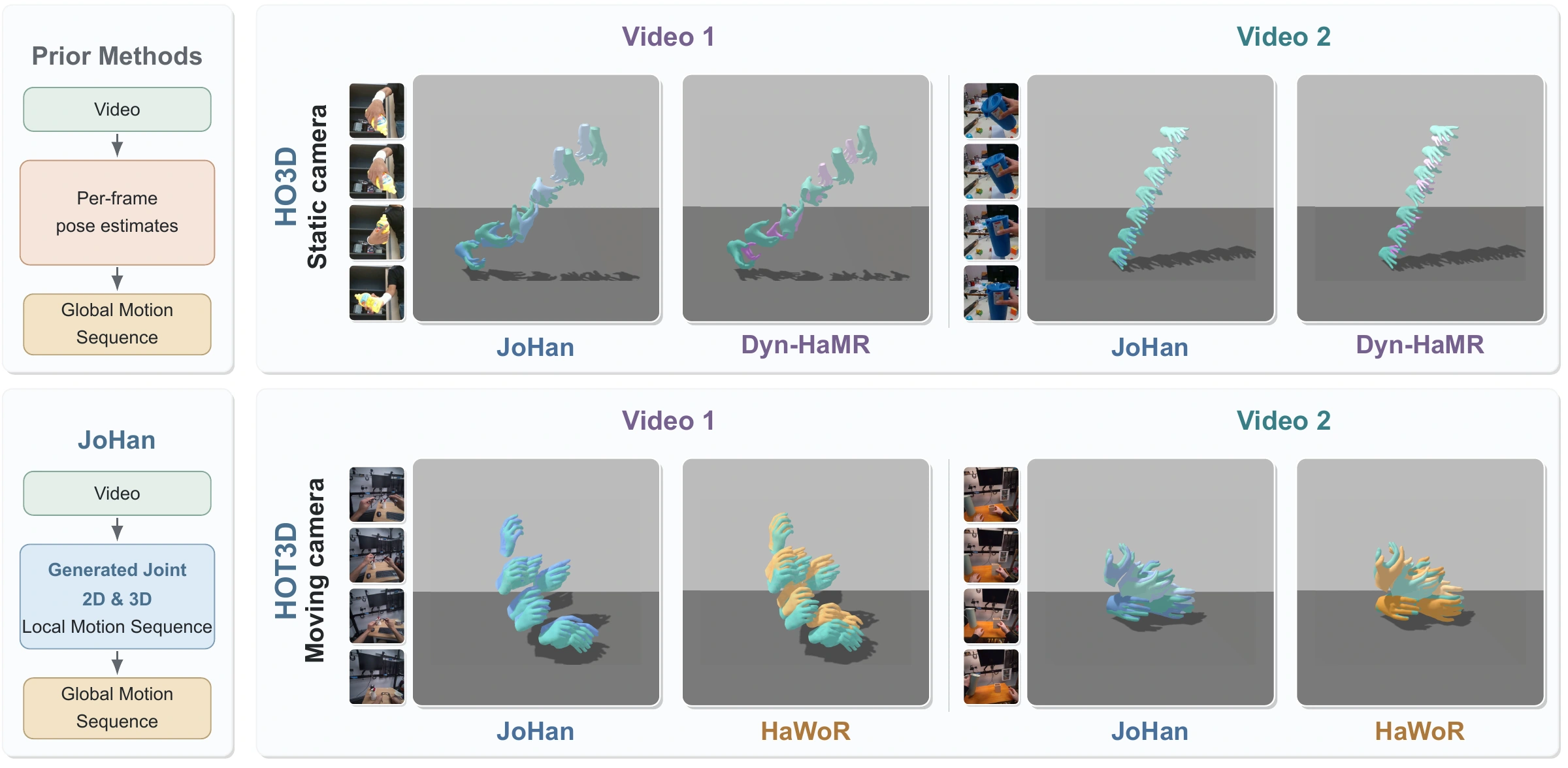
A joint motion prior
Two modality-specific generators learn 2D and 3D local motion within one flow-matching process. Both motion states evolve along the same generation timeline, conditioned on full-frame video features.
Joint 2D–3D generation · Monocular video
1The University of Hong Kong 2UC Berkeley
Accurate, smooth hand motion.
Generated directly from video.
See it in motion
Explore aligned joint trajectories and mesh recovery
across static and moving camera views.
Both panels show the same frames. The left panel overlays 2D joints; the right panel places the recovered mesh in the camera view.
Interactive reconstruction
Rotate the view. Explore the trajectory.
A moving hand, in a reconstructed HOT3D scene.
Scene context uses recorded RGB, saved SLAM depths, and dataset camera poses.
Load the interactive mesh to rotate, zoom, and play the sequence.
Selected HOT3D sequence with visible hand movement.
Scene points come from recorded RGB and saved SLAM depths, registered with dataset cameras. They provide partial scene context, not a JoHan output. Hand predictions retain the evaluation’s first-aligned world coordinates. This selected example is independent of the videos above.
02 / The core idea
Learn local hand dynamics.
Recover global placement geometrically.
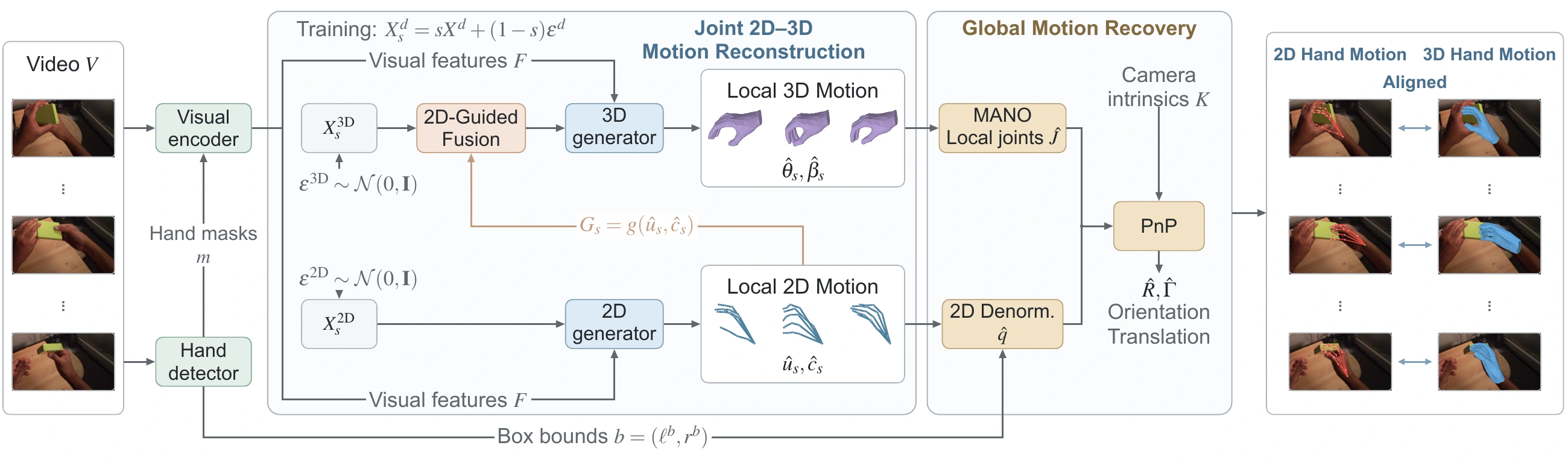
Two modality-specific generators learn 2D and 3D local motion within one flow-matching process. Both motion states evolve along the same generation timeline, conditioned on full-frame video features.
At every flow step, the predicted clean 2D joints provide visibility-weighted guidance to their corresponding 3D joints. This lets the 3D generator use the evolving 2D geometry throughout reconstruction.
After restoring the image-plane location and scale of the 2D poses, a PnP solver uses the 2D–3D correspondences and camera intrinsics to recover global orientation and translation.
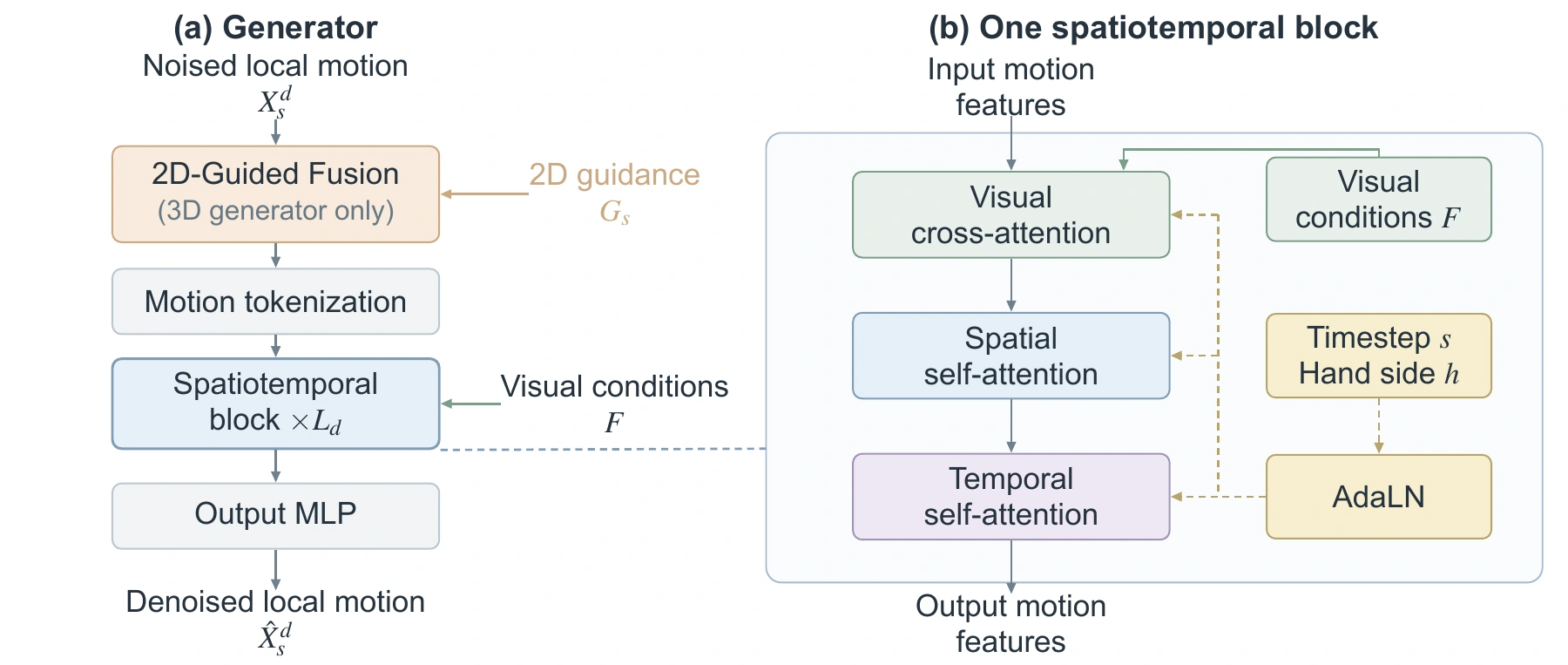
Visual cross-attention introduces image evidence, while spatial and temporal self-attention model joint relationships and motion across frames. Timestep and hand-side information condition the generators through adaptive layer normalization.
Reference
If you find this work useful, please cite our preprint.
@misc{xu2026johan,
  title  = {Video-Conditioned Generative Joint
            2D-3D Hand Motion Recovery},
  author = {Xu, Chen and Li, Yunqi and Huang, Binbin
            and Yi, Brent and Gao, Shenghua and Ma, Yi},
  year   = {2026},
  eprint = {2610.10512},
  archivePrefix = {arXiv},
  primaryClass = {cs.CV},
  url    = {https://arxiv.org/abs/2610.10512}
}